
AI in Online Exams: Everything Students Need to Know
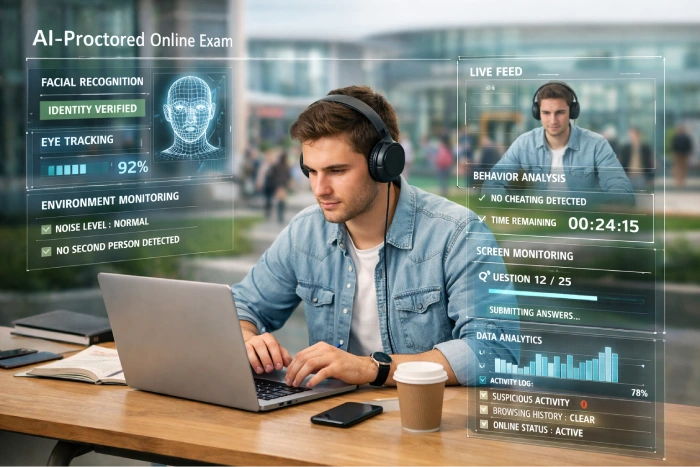
The higher education invigilator wearing a human face is becoming a far cry. Today, how universities use AI in online assessments affects every student, from how they are identified at the start of the test to how their answers are marked at the end.
Artificial intelligence in online exams is now almost the norm. The software keeps track of behaviour in real time, checks candidate identity and, in some instances, assesses written answers. We see students in these systems every day at online exam help, and the same questions keep coming up: What is being monitored, how precise is it, and what happens if it fails? This guide provides clear and factual answers to all those questions.
What Is AI-Based Online Assessment?
AI-Based Online Assessment is the use of Artificial Intelligence (AI) technologies such as machine learning, computer vision, and natural language processing (NLP) to monitor or grade exams online without the need for constant human supervision.
Two popular models should be distinguished:
- AI-only proctoring: Software automatically detects and flags behaviours; no human proctoring during the session.
- Hybrid proctoring: AI identifies potentially suspicious behavior and alerts a human proctor to review it before taking any action.
The majority of universities and certification bodies are now applying the hybrid approach. In most institutions, a fully automatic flag is not followed by a penalty unless a human reviewer has done so first.
Key Ways Universities Use AI in Online Exams
- Identity Verification
AI exam monitoring software generally asks the candidate to confirm their identity before the start of an exam by comparing their face with the image on their photo ID. The system will match the real-time video stream with the student’s photo in its database to verify a correct student is taking the test.
Some platforms use facial recognition in online exam system to make periodic re-verification checks, and in the case where the face detected in the examination is not the face registered in the platform, it will be notified. One of the most frequent causes of post-exam review.
- Behavior and Anomaly Detection
During an exam, AI cheating detection software monitors multiple behavioral patterns at once:
- Visual signals: Computer Vision tracks eye gaze, head position, and eye movements. When watching the screen continuously is logged as a flag.
- Room and audio monitoring: Microphones monitor background noise, whispers, or noises associated with external help.
- Device behavior: Algorithms detect tab switching, application changes, or copy/paste behavior that is outside of normal exam behavior.
- Typing rhythm analysis: A few types of typing software measure the pattern of user typing and look for strange pauses or shifts in typing tempo that might suggest the user is consulting external information.
All these signals are recorded and marked. They may or may not have an impact depending on the threshold parameters which are applied by the institution and the fact that a human reviewer is involved in evaluating the flagged session.
- Automated and AI-Assisted Grading
AI grading online exams is now standard for objective question formats. All multiple choice and true/falses and structured numeric answers are marked immediately and consistently. Natural language processing models are increasingly used to score natural language short written responses by checking grammar, relevance, and key concept coverage.
- Plagiarism and AI-Generated Content Detection
Work submitted for exams is regularly checked against material found online and in academic journals for plagiarism. In recent years, some have begun to incorporate text-pattern analysis software into their platforms to identify responses with statistical features that indicate AI-generated text.
- Adaptive and Data-Driven Test Design
Some AI-driven exam platforms can dynamically alter the difficulty of the questions as per the candidate’s performance. This is a method that is employed in popular and widely used standardized tests to enable the measurement of abilities with greater precision over a shorter set of questions, without compromising the ability to measure the subjects, which reduces the time of the overall exam.
Benefits of AI in Online Assessments
AI proctoring has been integrated by universities and testing entities for several practical reasons:
- Scale: AI proctors can monitor thousands of candidates at once at the same time without having to hire a proportional number of human proctors.
- Consistency: For objective question types, there is no variability between markers, as markers are all automated.
- Auditability: All flagged events are timed and recorded, and there is a documented trail for fair investigations of academic integrity.
- Accessibility: Students can take exams from any place with an internet connection, eliminating the need to go to a test centre.
Challenges and Concerns With AI Proctoring
While these benefits are significant, academic integrity and AI monitoring tools come with recognized drawbacks that must be acknowledged by students and institutions alike.
- False Positives
These are some of the more frequent questions. For instance, when a student looks up to retrieve information, this can be mistaken as a suspicious act by the AI system. These flags are based on statistical thresholds, not context, which means that normal cognitive function in a high-pressure test scenario could trigger flags.
- Privacy Concerns
There have also been privacy and legal issues raised. Some virtual room scans have asked students to take their cameras around their homes, sparking controversies over the limits of institutional surveillance in the home. There have been some formal complaints from student groups and regulators about the extent of remote monitoring at several universities.
- Bias
In general, facial recognition systems have been shown to suffer from algorithmic bias. It is inaccurate across different skin tones and lighting conditions, leading to fairness concerns among students with less natural light in their surroundings and those from demographic groups that were underrepresented in training sets.
- Student Stress
Another less technical, but equally real concern is test anxiety amplification. Being always on guard may cause stress on its own, regardless of how well the student is prepared, and thus impact performance.
All of these factors make it advisable for most institutions to tie AI proctoring flags to required human review before academic consequences.
Which Exams Commonly Use AI Proctoring in Universities?
AI test proctoring is integrated into numerous professional certification programs, not just academic programs:
- Business and management:GMAT adopts AI-powered remote proctoring for their online exam format, and they have behavior monitoring and identity verification throughout.
- Graduate admissions: The GRE at-home format provides test integrity remotely with adaptive testing technology and AI proctoring.
- Project management: ThePMP exam is available online, supervised by AI and tested by PMI’s test partners.
- IT certifications: CompTIA certifications, such as A+, Network+, and Security+, can be delivered online via AI proctored.
- Nursing admissions: There is AI-assisted monitoring for both the HESI and TEAS exams when they are offered remotely; behavior monitoring and identity verification are standard for both exams.
Tips for Students Taking an AI-Proctored Exam
Understanding what AI systems watch helps you to prepare without unnecessary flags:
- Practice with equipment beforehand. To prevent setup problems that may cause delays or invalidate your exam, check your camera, microphone, and lighting before the exam date.
- Clear your environment. Keep second screens, books, notes, and hand-held devices off the desk and out of sight to prevent object-detection alerts.
- Maintain a close shot. Keep subjects close to the frame. Don’t lean back, stand up, or leave the shot during the exam.
- Minimize verbal behavior. Questions can be read aloud or said to oneself, which can lead to audio analysis flags.
- Be familiar with the appeal process. If flagged, know your institution’s formal review process before the exam and be able to respond calmly, if necessary.
Frequently Asked Questions
- Is AI proctoring the same as human proctoring?
No, AI proctoring uses software to monitor behavior automatically, while human proctoring involves a live person watching; most universities now use a hybrid model where AI flags issues for a human to review.
- Can AI proctoring software falsely accuse a student of cheating?
Yes, false positives can happen when normal behavior like looking away to think is misread as suspicious, which is why most institutions require human review before any penalty is applied.
- What does AI actually monitor during an online exam?
Common signals include face and eye position, background noise or voices, tab-switching, typing patterns, and the presence of unauthorized devices or people in the room.
- Do universities use AI to grade exams?
AI grades objective questions like multiple choice instantly, and increasingly assists with scoring short written responses, though essays and high-stakes writing are usually still reviewed by a human.
- How can I avoid being flagged during an AI-proctored exam?
Test your equipment beforehand, keep your desk and room clear of unauthorized items, stay within the camera’s view, and avoid talking to yourself or leaving the frame during the test.
Conclusion
AI has become an integral and growing component of online assessment for identity verification, behavior monitoring, and now, more than ever, grading. The best preparation any student can make before taking an AI-proctored exam is to grasp how these systems function and what their limitations are.
Should you have a test coming up that is being monitored by AI and are wondering what you can do or are looking for structured support, Contact Us, and we will help you proceed with confidence.