
How to Use Practice Tests to Find Knowledge Gaps Before an Online Exam?
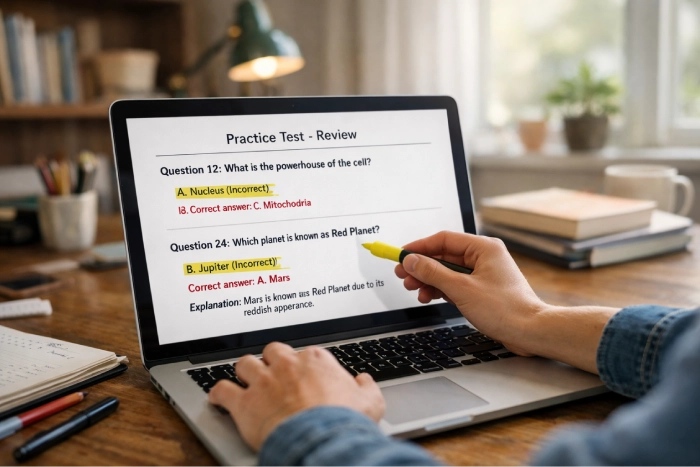
Using practice tests to find knowledge gaps, recording every mistake by topic and error type, restudying those topics, and testing yourself again after 24 hours makes your preparation even better. This process reveals what you actually know and retain before your exam. A practice test should use legitimate materials, including past papers, instructor-provided questions, official question banks, or self-generated quizzes.
Most students actually take practice tests but never review them properly, which is why their scores don’t improve. Instead of repeatedly studying entire chapters, identify your knowledge gaps and measure your progress throughout the other attempt. In this post, let’s see how to use a reliable practice test to make online exam preparation even better.
Why Practice Tests Find Gaps That Re-Reading Hides
Re-reading your notes can be helpful, but being able to recognise information is not the same as remembering. This is also known as the fluency illusion; text that is easy to read will give you a false sense of understanding. We see what we know when we try to answer questions without looking at our notes.
One thing to consider with retrieval practice is that you have to remember information for yourself. This is also called active recall, and it can strengthen your memory of the information. You might find knowledge gaps in your knowledge during practice that show you don’t fully understand the concepts, which a simple summary won’t help you with. However, the use of a practice test will show you the areas you need to improve on before the real thing.
To close the knowledge gaps, revise the incorrect answers, understand why they are incorrect, and test yourself again. Try active recall of what you know before checking your notes to put active recall into practice. If continually re-reading is your usual method of revision, find out why students struggle with online exams. Always remember, a practice test serves as a diagnostic tool and not a score.
The Four-Stage Practice Test Schedule
Schedule practice tests to find knowledge gaps before it’s too late, rather than realising it during your last review. Use a practice test at each stage to ensure understanding of weak areas, correct mistakes, and prepare strategically.
Use the following 4 steps as a guide to spacing out your practice test rather than cramming it all into one mock exam.
| Stage | When | Test Type | What to do with the result |
| Orientation | After reviewing the exam objectives | Short diagnostic | Rank topics by weakness |
| Core Learning | After each major topic | Topic quiz | Fix misunderstandings before moving on |
| Mid-point review | After covering about half the content | Mixed practice test | Check older topics are still sticking |
| Final review | After covering everything once | Full timed simulation | Measure timing, stamina, readiness |
During orientation, establish your baseline. After each major topic, review wrong answers before proceeding further. At the midpoint, check if the taught material is still familiar to you, and finally, simulate the real exam and test your knowledge under the time constraints
Full-length tests are rare, and most of the diagnostic work is done during timed short quizzes.
The 5-Column Error Log (The Actual Method)
An error log is a good way to turn your practice test results into a study guide. Make sure to record not only which answers you got wrong but also why you got them wrong and what you plan to do next time to avoid getting them wrong. Here is an example table that you can copy into your notes or spreadsheet and fill out whenever you take a practice test.
| Question | Topic | Error Type | Root Cause | Next Action |
| Q14 | Acid–base balance | Knowledge gap | Never learned the buffer equation | Restudy + 10 practice questions |
| Q22 | Employment law | Comprehension gap | Missed the word “except” | Slow down on qualifiers |
Classify the error log into five mistake types and select the relevant solution for your weak areas.
- Knowledge gap: You did not know the information. Restudy the source materials, then reconstruct the explanation from memory without looking at the notes.
- Comprehension gap: You have misread the question. Practice reading questions more slowly and carefully, especially qualifiers and command words such as compare, identify, and evaluate.
- Process error: You knew what to do, but performed incorrectly due to pressure. Go through the process again from start to finish and identify where you went wrong.
- Pacing error: You knew the information but ran out of time. Practice timed exercises and implement time management techniques to overcome the pacing error.
- Platform error: You knew the information but performed incorrectly due to interface confusion. Practise navigating online multiple-choice interfaces as part of your revision.
The one vital exception is to note down any questions that you have guessed correctly or incorrectly. Correct answers can disguise gaps in knowledge, because correct outcomes have not necessarily involved correct methods.
Update a self-marking error log after each practice test, with remedial actions for further revision. Focussing on the log, rather than ineffective rote revision, will enable you to identify patterns of weakness and to intervene productively
Turn the Log Into a Study Plan
To turn the log into a study plan, rank topics according to their frequency and weight. For instance, a problem that occurs five times in a heavily weighted topic is of more importance than one mistake in a 5% topic. To improve the identified weaknesses and overcome the knowledge gaps, it is essential to focus on the particular concept and not re-read or re-test the whole chapter.
The step in the process that most students miss or abandon is the re-test after the initial testing. It is critical to reschedule the re-test process within 24-48 hours to monitor progress and determine if the weak topics are improved. After completing the first stage of testing, it is important to take another practice test on the identified concept to ensure the improvement was achieved.
To make sure the knowledge gaps are permanent, it is essential to implement spaced repetition on the weak spots and then schedule a final re-test.
Five Practice-Test Mistakes That Waste the Time
Common practice test mistakes students make when preparing for online exams, which actually result in a waste of their time, are:
- Preparing for tests on the internet: It can be challenging because of the different ways a practice test is being taken.
- Learning questions instead of concepts: This happens because tests in some cases are randomised.
- Skipping short topic assessments: These assessments can help identify specific knowledge gap better than full-length practice tests.
- Forgetting to review: It is important to understand why an answer is correct rather than simply learning what the correct answer is.
- Guessing on purpose: Many students forget that they may have gotten some answers wrong if they guessed. They actually don’t use practice tests to find knowledge gaps; instead, they just go with the flow.
- Not practising under timed conditions: It is important to time oneself while practising online assessments as well as take timed assessments periodically.
Frequently Asked Questions
How many practice tests should I take before an exam?
Take many short quizzes and a few full exams. After every section, take a topic quiz as a practice test. Take one or two mixed tests halfway through, and one or two timed simulations during the final week. Mistakes matter more than the number of tries.
Should I take a practice test before or after studying?
Taking a practice test at the beginning will help you identify what you need to study, while a test after studying will help you determine what you’ve learned. A test is a diagnostic tool that helps you identify knowledge gaps, your weaknesses and allows you to focus on what you need to study rather than relearning everything.
What should I do after a bad practice test score?
Record your errors in your error log, study what you missed, and then retest after one or two days. A bad test helps you identify your weak areas and what to study.
Is doing practice questions better than re-reading notes?
It’s better to take a practice re-test than read over your notes. Reading over your notes tells you what you know, but a practice test tells you what you don’t know. It’s important to identify your knowledge gaps in knowledge so that you can study those areas more closely. A practice test is a diagnostic tool that helps you identify your weaknesses, active recall, and allows you to focus on what you need to study rather than relearning everything.
Conclusion
Using practice tests to find knowledge gaps, track errors in an error log, troubleshoot them, and check improvements with a subsequent assessment. Need a reliable academic guide to overcome your knowledge gap? Check out the Take My PMP Exam For Me service to get acquainted with the help offered. Make sure to use genuine study guides, and remember that the rules may differ depending on the educational facility, so double-check your course guidelines.