
How Canadian Universities Maintain Fairness in Online Assessments
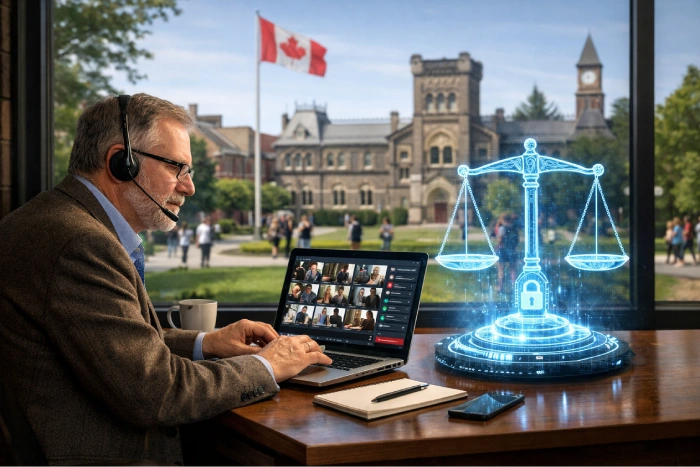
There are four separate mechanisms for ensuring fairness in online assessments, and four different bodies for ensuring them. They are for procedural fairness for academic decisions, provincial privacy law, obligations of accommodation, and assessment design. This article elucidates the working of each mechanism in Canadian universities online exams, where the system is still lacking. To grasp the technical aspect first, check out how online proctored exams work at Canadian universities.
There Is No National Standard
Education is a provincial responsibility in Canada. There is nothing federally mandated to regulate Canadian universities online exams, and no national policy on generative AI in higher education. They have been sought after by commentators. It hasn’t been created yet.
The real-world implications are that the online assessment policy is determined by institution and sometimes by faculty. Different rules may apply to the same type of examination for two students on different campuses or in different departments of the same campus.
The variations continue with privacy law, as the privacy laws of public-sector organizations vary by province. Students’ sense of inconstancy is not coincidental; it is structural. It mirrors the structure of academic integrity Canada governance.
Mechanism 1 — Procedural Fairness
This is the one student process they know the least about and are best served by. It is generally expected that Canadian universities conducting academic misconduct decisions will adhere to a standard of procedural fairness.
In general, the student should be aware of the allegation, have a genuine opportunity to respond, and have the decision reached by an impartial decision-maker with reasons given. That is why institutions have policies for dealing with integrity, which have clear stages, timelines, and an academic appeal process, which do not leave it up to an individual instructor to decide without any consultation.
Certain recent changes made it clear that the emphasis is on procedural consistency, clearer timelines, and the difference between lower-level course-based dishonesty and more serious dishonesty that impacts academic standing.
The practical reality is that, for students, the practical flag is an allegation that must be examined, not a finding of misconduct. The academic appeal process is in place to challenge that claim. It is important to note that procedures differ from institution to institution and province to province, and it is not legal advice; always check your institution’s procedure as it will impact fairness in online assessments directly.
Mechanism 2 — Privacy Law and Data Residency
Proctoring software collects biometric data, room video, screen activity, and network information. Canadian public-sector privacy legislation gives institutions the right to collect personal information only when it is required for a “legitimate purpose”. Legal commentators have suggested that, on its own, a general reference to academic integrity is not enough to count.
That’s why Canadian universities need to conduct a privacy impact assessment and vendor risk assessment before implementing a proctoring tool, which is an essential component of online proctoring privacy Canada governance.
Some institutions specifically mandate that recordings be kept on Canadian servers, and mandate that vendors’ contractual obligations prevent the use of student data for other purposes, such as training their own models.
The Office of the Privacy Commissioner of Canada-funded research has called into doubt whether having students consent to being proctored is truly a free choice when they can choose to not write the exam instead. This is a current issue, and it has a direct impact on the design and evaluation of Canadian universities online exams.
Mechanism 3 — Accommodations and Accessibility
Institutions are responsible for providing reasonable accommodations for students with disabilities, and this applies to the extra time for students to complete online assessments, alternative formats, alternative to proctored delivery, or permitted assistive technology.
This particular online problem is that behaviour-flagging systems are able to mark a student for behaviour that is a consequence of a disability, and not of misbehaviour.
Research on Canadian higher education has argued that exam accommodations Canada policies are often framed within an assessment-security mindset rather than an integrity one. This places accommodation as a possible loophole to be policed, not supported, which forms the basis for current discussion on fairness in online assessments, a critique that informs the discussion.
The practical application: make sure to submit exam accommodations Canada requests early in the term and to be clear about their impact on proctored online exams. Some approvals do not carry over from one exam format to another.
Mechanism 4 — Assessment Design
Perhaps the most effective is to design assessments in which surveillance is less important in the first place. Some of the approaches being used involve open-book exams that focus on application, rather than recall; the use of randomized question pools, shuffled options, larger question banks, staged assignments with drafts, oral components, and course-specific scenarios that cannot be answered with generic responses. Each reflects a shift in online assessment policy away from detection and toward design.
The trade-off is real: these formats are fairer and harder to cheat on, but they cost more staff time per student. This is why adoption is uneven across Canadian universities online exams and even between faculties at the same institution.
Given the pervasive use of generative AI in academic work by Canadian students, and the fact that several institutions have determined that redesigning assessment is a sustainable approach to a more meaningful shift in academic integrity Canada strategy rather than escalating detection efforts. To understand how format choice affects fairness directly, see how an online quiz differs from an online exam.
Where the System Still Falls Short
This system is not without documented problems:
- Inconsistency. There are different rules for different institutions, faculties, and individual teachers, and students feel these are arbitrary.
- Detection accuracy. But there are concerns about false positives and bias in AI detection tools, and some institutions limit or prohibit their use because of these concerns.
- The burden of appeal. Even if it is a fair process, it takes time, stress, and sometimes free academic labor for the student to defend himself.
- Unequal conditions. Proctored exams are assumed to have a private room, reliable internet access, and a suitable device, which is not equally available to all students.
- Consent under pressure. Acknowledging surveillance for not failing a course is not the same as freely consenting to the surveillance a concern that is central to an ongoing online proctoring privacy Canada debate.
None of this negates fairness in online assessments as a goal. It does mean the goal is imperfectly achieved. For a deeper look at related challenges, see why students struggle with online exams.
What This Means for You as a Student
There are some practical measures to safeguard you in this system:
- Read the academic honesty policy at your school as soon as you have to.
- Locate the academic appeal process and its due date right now; appeal windows are brief.
- Please book rooms early and verify their application to proctored delivery.
- Request information regarding what data a proctoring tool collects, where it is stored, and the length of time that you are entitled to request.
- If flagged, reply formally and document in writing.
Most students don’t realize how important it is to understand these mechanisms before taking a Canadian universities online exams until something goes wrong.
Frequently Asked Questions
- Can a Canadian university require me to be recorded during an exam?
Yes, in general, provided it is discussed in course policy, but it must be supported by a rationale under online proctoring privacy Canada obligations, and provide alternative options where necessary.
- What happens if proctoring software flags me?
Typically, a flag is not a penalty, but a call for human review. Refer to your institution’s misconduct policy for the exact procedure.
- Can I appeal an academic misconduct decision?
Most institutions have a formal appeal process with specific deadlines – find your appeal process ahead of time as windows are short.
- Where is my proctoring data stored?
This will depend on each institution and the vendor contract; some institutions do require Canadian data residency. Please consult your exam accommodations Canada office directly.
Conclusion
The four mechanisms of fairness in online assessments, and knowing them is your protection. Have questions about taking an online exam? Contact OnlineExamHelp today.